
A consultation is around fifteen minutes with a doctor, and you are the person who knows your body best. The doctor wrote this because a few simple things, done before and during a visit, make a real difference to what can be achieved for you in that time. It works with any GP, not only this one. By the end you will know how to prepare, what the doctor will ask, the questions worth asking, and there is a one-page sheet to fill in at home and put on the table.
Why is a consultation like a puzzle?
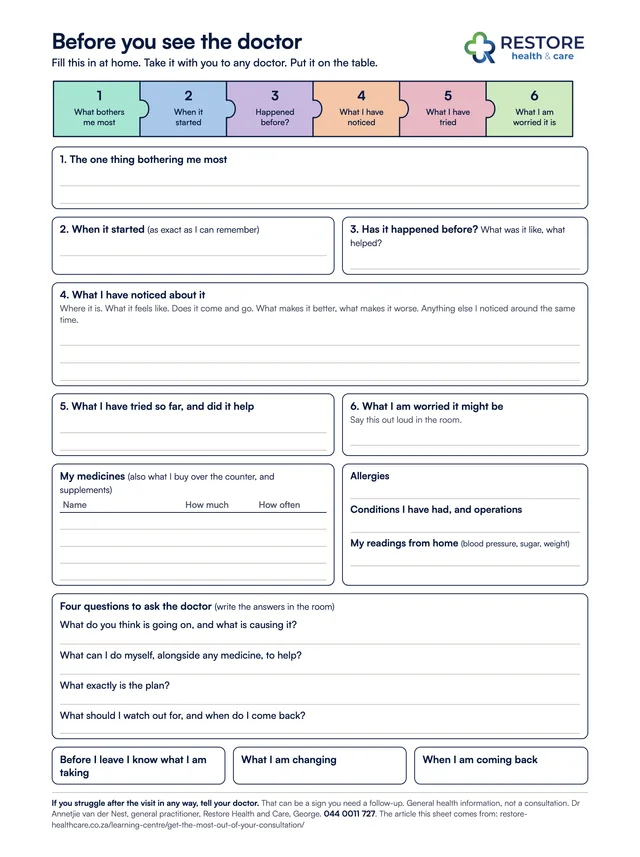
Think of a consultation as a puzzle. You walk in with most of the pieces in your pocket. The doctor's job is to put them together into a picture, and then make a plan from that picture. So the more pieces you put on the table, the better the picture.
How do you prepare before the visit?
It starts the night before. Take a few minutes and think about why you are going. Write it down if it helps. A short note helps a lot, because once you are sitting in that room, things get forgotten.
Write down a list of your current medicines, with the dosages. Include the things you buy over the counter, and your supplements. If you check your blood pressure, your sugar or your weight at home, bring those numbers along. Results or letters from another doctor are welcome too. What to expect on the day, from reception to the consulting room, is on the page on your first visit.
Decide on your most important concern. If you come with five problems, each one gets three minutes. Come with the one that bothers you most, and it gets the attention it deserves.
What will the doctor ask you?
In the room the doctor will ask you a few things, and how precisely you answer makes a big difference. A few examples of what she might ask:
- What is bothering you most?
- When did it start? Be as exact as you can remember.
- Has it ever happened before? If it has, what was it like then, and what helped?
- What have you noticed about it? Where it is, what it feels like, whether it comes and goes, what makes it better or worse. The small details are often the ones that help most.
- What have you tried so far, and did it help?
She will also want to know about your general health: conditions you have had, operations and allergies. This is where the list you wrote at home makes it quick and easy.
Which piece do people keep in their pocket?
If you have a worry about what this might be, say it. So many people keep that to themselves, and leave without an answer to the very thing that brought them in. If you say it, the doctor can look for it, test for it, or explain to you why it is not that.
Which questions are worth asking?
Once the doctor has the picture, it is your turn to ask. Four questions are worth asking.
- What do you think is going on, and what is causing it?
- What can I do myself, alongside any medicine, to help?
- What exactly is the plan? Make sure you understand it before you leave.
- What should I watch out for, and when do I come back?
Something else to keep in mind
Medicine treats the problem. The things you do every day, your sleep, your food, how you move and how you handle stress, treat the reason behind it. Work on both together. That is where the results come from.
What helps after the visit?
Before you leave, know the plan: what you are taking, what you are changing, and when you are coming back. If anything is unclear, ask. It is much easier to sort out in the room than at home. Any change to your plan or your medicine, you decide together with the doctor.
If you struggle after the visit in any way, tell the doctor. That is a sign you might need a follow-up consultation.
Is there a sheet you can fill in at home?
Yes. Everything above is on one page: download the sheet, print it, fill it in at home and put it on the table. It works with any doctor, not only this one.
How do you book?
How a consultation with the doctor works is on the page on general consultations. You can book on WhatsApp or by phoning the rooms on 044 0011 727. If it is an emergency, do not wait for an appointment. Go to the nearest emergency unit, or phone 10177 (ambulance) or 112 from a cell phone.
References
- What to ask your doctor or other healthcare professional. NHS (UK National Health Service), 2023.
- Questions are the answer. Agency for Healthcare Research and Quality (US), 2024.
- Ask Me 3: good questions for your good health. Institute for Healthcare Improvement (US), 2024.
